zProtocol: A Framework for Compliant Institutional Tokenization
1. Introduction
Tokenization of real-world assets (RWAs) is rapidly moving from experimentation to institutional adoption. Banks, asset managers, and capital markets infrastructure providers are increasingly exploring blockchain-based tokenization to unlock liquidity, improve settlement efficiency, and expand access to private market assets.
However, while early blockchain token standards enabled digital asset creation, they were not designed for regulated financial instruments. Institutional assets require strict compliance controls, complex ownership structures, and lifecycle management capabilities that traditional token standards cannot easily support.
This is the foundation behind zProtocol, a tokenization framework developed by Zoniqx and built around the Dynamic Compliant Interoperable Security Token (DyCIST) standard, ERC-7518. Designed specifically for real-world asset tokenization, the standard introduces a flexible structure that supports complex ownership models, programmable compliance, and interoperability across digital asset ecosystems.
As financial markets continue to explore tokenized asset infrastructure, frameworks like zProtocol aim to bridge the gap between blockchain technology and the operational realities of regulated capital markets.
2. The Infrastructure Challenge Behind Institutional Tokenization
While blockchain technology offers clear advantages for financial markets, institutional adoption depends on infrastructure that aligns with regulatory and operational realities.
Tokenized real-world assets must support:
- Regulatory compliance and investor eligibility checks
- Transfer restrictions across jurisdictions
- Complex asset ownership structures
- Lifecycle management of securities
- Secure recovery and administrative control mechanisms
Traditional token standards such as ERC-20 were built primarily for fungible cryptocurrencies and lack native compliance and governance capabilities.
Similarly, although ERC-1155 introduced multi-token functionality, it does not fully address the specific needs of regulated securities markets.
As tokenization expands into asset classes such as real estate, private equity, and investment funds, the industry requires a token standard that can natively support compliance management, flexible ownership structures, and interoperability with financial infrastructure.
This is the problem that ERC-7518 was designed to solve.
3. Introducing the DyCIST Standard (ERC-7518)
Supporting the tokenization of regulated financial assets requires more than simply representing ownership on a blockchain. Digital securities must reflect the structural complexity and compliance requirements that exist in traditional capital markets.
The Dynamic Compliant Interoperable Security Token (DyCIST) standard, ERC-7518 was developed to address these needs.
Built as an extension of the ERC-1155 multi-token standard, ERC-7518 introduces a partition-based architecture that allows multiple asset units with distinct characteristics to exist within a single token contract. This design enables issuers to represent complex ownership arrangements without deploying separate contracts for each asset class.
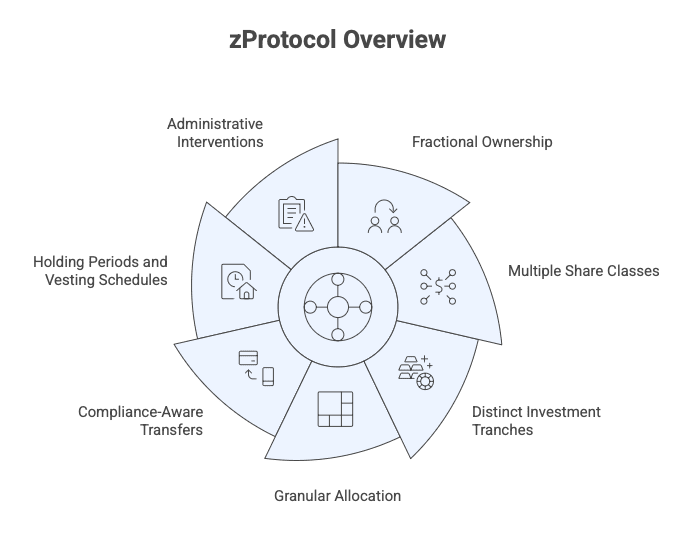
Through partitioning, tokenized assets can support structures such as:
- Fractional ownership of real-world assets
- Multiple share classes within a single investment vehicle
- Distinct investment tranches with different rights or restrictions
- Granular allocation of ownership units across investor groups
These capabilities are particularly relevant for asset classes such as commercial real estate, private equity funds, infrastructure projects, and structured investment vehicles, where ownership structures are rarely uniform.
In addition to structural flexibility, ERC-7518 incorporates features designed for regulated markets, including mechanisms that support:
- Compliance-aware token transfers
- Holding periods and vesting schedules
- Administrative interventions when required for regulatory oversight
By embedding these capabilities directly into the token architecture, ERC-7518 allows digital asset representations to more closely mirror the operational and compliance frameworks used in traditional financial markets.
4. Key Architectural Capabilities of ERC-7518
ERC-7518 introduces several architectural features that enable tokenized assets to operate within institutional and regulated environments.
4.1 Partition-Based Token Architecture
The partitioning mechanism allows multiple asset segments to coexist within a single token contract. Each partition can represent a distinct ownership unit or financial structure.
Examples include:
- Different share classes within an investment fund
- Tranches within structured investment products
- Separate allocations for institutional and retail investors
- Distinct ownership slices within fractionalized real estate assets
This structure allows tokenized instruments to replicate the complexity of traditional financial products while maintaining operational simplicity at the contract level.
4.2 Dynamic Compliance Management
Regulated assets require transfer controls that enforce investor eligibility and jurisdictional restrictions.
ERC-7518 enables compliance validation through dynamic mechanisms such as off-chain vouchers, which can confirm whether a transaction satisfies predefined regulatory requirements.
These mechanisms can support:
- KYC and AML verification
- Accredited or qualified investor checks
- Jurisdiction-based transfer restrictions
- Holding-period enforcement
Because compliance rules can evolve, separating validation from the core token logic provides greater flexibility for issuers and administrators.
4.3 Institutional Safeguards
Security tokens must incorporate safeguards that allow issuers and regulators to intervene when necessary.
ERC-7518 includes several administrative controls, including:
- Token locking for vesting schedules or regulatory holding periods
- Address freezing to prevent transfers during compliance investigations
- Forced transfers to recover assets in cases such as lost private keys
These features reflect operational practices commonly used in regulated securities administration.
4.4 Interoperability and Market Connectivity
Integration with broader blockchain infrastructure remains critical for adoption.
ERC-7518 supports interoperability through mechanisms that allow tokens to interact with other standards and platforms, including:
- Wrapping ERC-7518 tokens into other standards (e.g., ERC-20)
- Unwrapping tokens back into their native format
- Backward compatibility with ERC-1155 wallets, exchanges, and applications
This flexibility enables tokenized assets to move across different blockchain environments while preserving their underlying compliance and ownership structure.
4.5 Payment Distribution Infrastructure
Many real-world assets generate income streams such as dividends, rental income, or profit distributions.
ERC-7518 provides mechanisms that support structured payment distribution to token holders.
This enables issuers to automate the distribution of:
- dividends
- rental income
- yield payments
- profit sharing
Payment distribution capabilities are essential for tokenizing income-generating assets such as real estate, infrastructure projects, and private investment funds.
5. Why zProtocol Matters for Institutional Markets
While ERC-7518 defines the token standard, institutions require a broader infrastructure layer to operationalize tokenization across the full lifecycle of an asset. Issuing a token is only one part of the process; regulated markets require systems that manage compliance, investor onboarding, asset administration, and distribution.
zProtocol was developed to provide this operational layer.
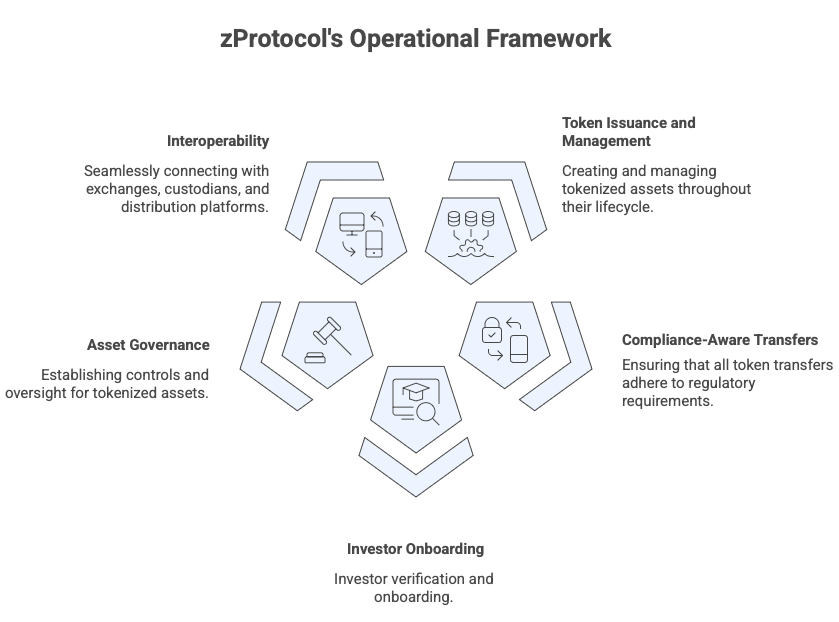
At its core, zProtocol enables financial institutions to issue and manage tokenized assets using ERC-7518 while integrating the controls required in regulated markets. The framework supports key operational functions such as:
- Token issuance and lifecycle management
- Compliance-aware asset transfers
- Investor eligibility and onboarding workflows
- Administrative controls and asset governance
- Interoperability with exchanges, custodians, and distribution platforms
By operationalizing the ERC-7518 architecture, zProtocol allows institutions to design tokenized assets that align with both blockchain infrastructure and traditional financial processes.
For banks, broker-dealers, and asset managers exploring tokenization, this type of infrastructure helps bridge the gap between technical token standards and real-world capital markets operations.
6. Real-World Applications
The architectural flexibility of ERC-7518 and the operational framework provided by zProtocol enable tokenization across a wide range of institutional asset classes.
Some of the most relevant applications include:
- Commercial Real Estate
Fractional ownership structures that allow multiple investors to hold programmable shares in a property or portfolio. - Private Equity and Venture Funds
Tokenized fund units with distinct investor classes, eligibility requirements, and transfer restrictions. - Infrastructure and Energy Projects
Tokenized ownership of long-term projects with automated distribution of revenue or yield. - Structured Financial Products
Investment structures with multiple tranches representing varying risk and return profiles.
By supporting these asset structures, tokenization frameworks like zProtocol can expand access to private markets while preserving the compliance and governance mechanisms required in institutional finance.
7. Conclusion
As tokenization moves from pilot projects to institutional-scale deployments, the infrastructure supporting tokenized assets must evolve accordingly.
ERC-7518 introduces a security token architecture specifically designed for regulated markets, combining flexible asset structuring with compliance-native functionality.
Through zProtocol, Zoniqx operationalizes this standard, enabling institutions to issue, manage, and distribute tokenized assets while maintaining regulatory alignment and interoperability across digital asset ecosystems.
Together, ERC-7518 and zProtocol represent a foundational step toward scalable, compliant, and interoperable tokenized capital markets.
8. FAQs
What is the ERC-7518 DyCIST standard?
ERC-7518 is a blockchain token standard designed specifically for security tokens and tokenized real-world assets. It introduces partition-based architecture and compliance mechanisms that enable regulated financial assets to be represented on blockchain networks.
How does ERC-7518 differ from ERC-20 and ERC-1155?
ERC-20 was designed for simple fungible tokens, while ERC-1155 introduced multi-token functionality. ERC-7518 builds on ERC-1155 by introducing partitioning and compliance mechanisms specifically designed for security tokens.
Why is partitioning important for tokenized assets?
Partitioning allows different ownership classes, tranches, or asset units to exist within a single token contract, enabling the representation of complex financial instruments such as investment funds and structured assets.
How does ERC-7518 support regulatory compliance?
ERC-7518 incorporates dynamic compliance through off-chain vouchers that validate token transfers based on regulatory requirements such as KYC, AML, and jurisdictional restrictions.
Can ERC-7518 tokens integrate with existing blockchain infrastructure?
Yes. ERC-7518 tokens are backward-compatible with ERC-1155 and can be wrapped into other token standards such as ERC-20 to enable interoperability with existing platforms.
What types of assets can be tokenized using ERC-7518?
Assets such as real estate, private equity funds, infrastructure projects, and structured financial products can be tokenized using the ERC-7518 standard.
How does zProtocol support institutional tokenization?
zProtocol operationalizes the ERC-7518 standard by providing infrastructure for compliant token issuance, lifecycle management, interoperability, and distribution across financial platforms.
About Zoniqx
Zoniqx is building the compliant internet of capital markets, the operating system for tokenized real-world assets. While most platforms stop at issuance, Zoniqx addresses the real bottleneck in tokenization: fragmented standards, manual compliance, and broken distribution. Through a vertically integrated, three-layer architecture spanning SaaS, network distribution, and protocol-level compliance, Zoniqx embeds governance directly into the asset itself, turning tokenization from isolated pilots into scalable, liquid capital markets. Proven at institutional scale across 20+ jurisdictions and Billions worth in tokenized assets, Zoniqx is powering the infrastructure required for the next generation of regulated, on-chain finance.
Learn more at www.zoniqx.com
Disclaimer
This article is for informational purposes only and does not constitute legal, financial, or regulatory advice. References to SEC are based on public statements and do not imply endorsement or legal interpretation. Readers are encouraged to consult with legal or regulatory professionals before engaging in asset tokenization. Zoniqx operates in full compliance with applicable laws and supports regulatory clarity in the tokenization ecosystem.


.jpg)