The Infrastructure Problem Behind the Private Markets Boom
Why Family Offices Are Reaching an Operational Breaking Point
Over the past decade, private markets have become a core component of institutional and family office portfolios.
For many multi-family offices, allocations to private equity, venture capital, private credit, and real estate now represent 25–40% of total portfolios. In some ultra-high-net-worth families, the allocation is even higher.
The logic is clear:
- access to long-term growth
- diversification away from public markets
- participation in innovation and real assets
But as private allocations grow, a less visible challenge is emerging.
Not capital.
Not deal flow.
Infrastructure.
The Silent Complexity Behind Private Market Portfolios
Private markets were originally built for institutional investors managing a small number of large positions.
Family offices operate differently.
A single UHNW portfolio today may include:
- 15–30 private equity funds
- multiple co-investments
- venture allocations
- real estate vehicles
- secondary market interests
Each investment often requires its own legal and administrative structure.
This creates a cascading operational stack:
- SPVs and holding vehicles
- custodians and administrators
- transfer agents
- compliance frameworks
- capital call management
- fragmented reporting systems
According to Preqin, global private market assets under management surpassed $13 trillion in 2023, and are expected to reach $18–20 trillion by 2030.
Yet the infrastructure managing these assets remains largely unchanged.
Much of it still relies on manual processes, spreadsheets, and siloed service providers.
The Administrative Burden of Scaling Private Portfolios
For family offices managing complex portfolios across generations, the operational burden compounds quickly.
A typical private investment lifecycle includes:
- legal structuring
- investor onboarding
- capital call management
- compliance monitoring
- periodic reporting
- secondary transfers
Each step introduces additional intermediaries and administrative layers.
A 2023 PwC private markets report highlighted that operational complexity has become one of the top three challenges for wealth managers increasing private allocations.
Not because the investments are unattractive.
But because managing them at scale is inefficient.
The Liquidity Constraint
Liquidity is another structural friction.
Private investments are designed to be long-term.
But family portfolios are not static.
Over time they must accommodate:
- generational wealth transfers
- portfolio rebalancing
- philanthropic allocations
- liquidity needs
Secondary markets exist, but participation is limited and processes remain slow and opaque.
According to McKinsey, the private equity secondary market exceeded $100 billion in annual transaction volume in 2023, yet this represents only a small fraction of the total private asset base.
The infrastructure for efficient transferability simply hasn’t kept pace with the scale of private markets.
Where Infrastructure Innovation Is Beginning to Emerge
Over the past several years, a new category of financial infrastructure has started to address these operational challenges.
Instead of treating private investments as static legal structures, they can now be managed through programmable asset infrastructure.
This approach enables:
- digitized ownership records
- automated compliance logic
- structured transferability
- unified lifecycle management
For family offices, the benefit is not technological novelty.
It is operational clarity.
Private assets can move from fragmented administrative systems toward coherent infrastructure that manages the full asset lifecycle.
Why This Matters for Family Offices
Family offices sit at a unique intersection of private markets.
They are:
- long-term capital providers
- direct investors in private assets
- stewards of multi-generational wealth
As allocations to alternatives grow, the real bottleneck will increasingly become operational scalability.
How efficiently can portfolios manage:
- multiple structures
- multiple jurisdictions
- complex reporting requirements
- long investment horizons
Infrastructure that simplifies these processes may ultimately become as important as the investments themselves.
How Zoniqx Solves the Infrastructure Gap in Private Markets
The challenge facing family offices and private market platforms is not access to investments.
It is managing the lifecycle of private assets efficiently at scale.
As portfolios expand across private equity funds, co-investments, real estate vehicles, and private credit structures, operational complexity grows rapidly.
This is where Zoniqx positions itself differently from typical tokenization providers.
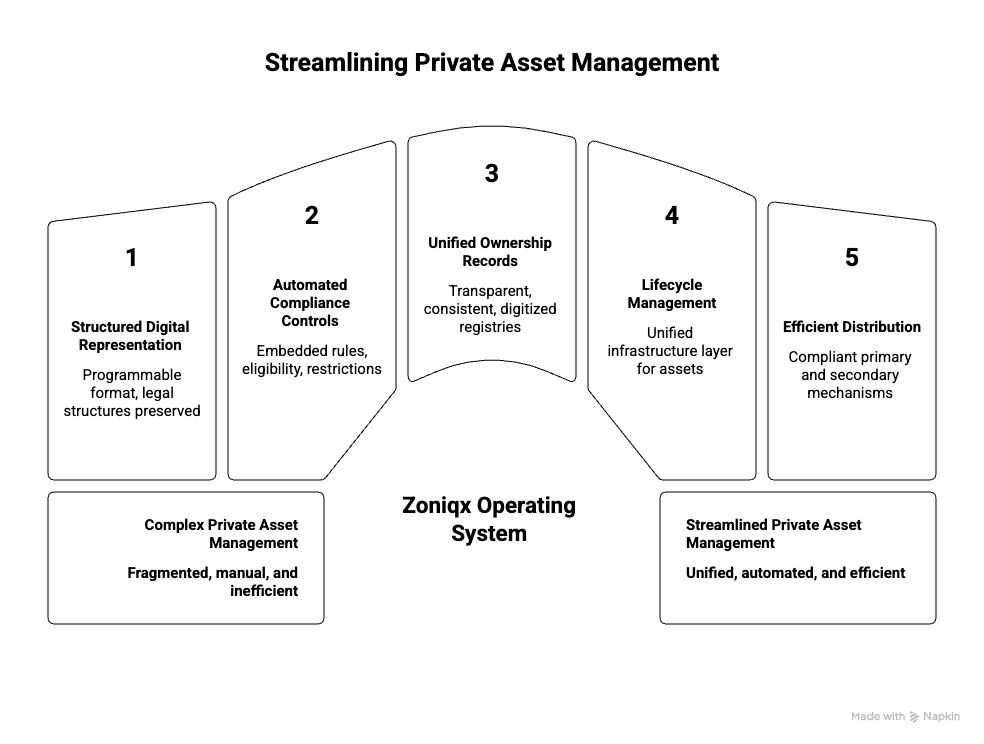
Zoniqx is designed as an Operating System for tokenized real-world assets — infrastructure that manages the full lifecycle of private market assets from structuring to distribution.
Instead of treating tokenization as a one-time event, Zoniqx focuses on operationalizing private assets across their entire lifecycle.
1. Structuring Private Assets in a Programmable Format
Private investments today rely on layered legal structures and manual administration.
Zoniqx enables asset issuers and structuring partners to represent private assets in a programmable format while preserving legal ownership structures.
This allows:
- structured representation of private equity funds, real estate assets, and private credit
- digitized ownership records
- standardized asset data across jurisdictions
For family offices and wealth platforms, this creates greater transparency and consistency across private portfolios.
2. Automating Compliance and Transfer Controls
One of the main barriers to scaling private markets is regulatory complexity.
Each asset must enforce:
- investor eligibility requirements
- jurisdictional restrictions
- transfer limitations
- regulatory reporting standards
Through Zoniqx’s programmable compliance layer, these rules can be embedded directly into the asset structure.
This enables:
- rule-based investor eligibility checks
- automated transfer restrictions
- compliant secondary transfers
The result is controlled liquidity without compromising regulatory safeguards.
3. Managing the Full Asset Lifecycle
Private investments typically involve fragmented processes across multiple service providers.
Zoniqx integrates these functions into a single operational layer.
The platform enables:
- asset issuance
- ownership tracking
- compliance monitoring
- distribution management
- secondary transfers
By unifying these processes, Zoniqx acts as the operating system that connects the lifecycle of private assets.
For institutions managing large private portfolios, this can significantly reduce administrative fragmentation and operational overhead.
4. Enabling Scalable Distribution
Private markets have historically been limited by inefficient distribution infrastructure.
Zoniqx enables compliant primary and secondary distribution through structured digital asset frameworks.
This allows asset managers and family offices to:
- manage investor participation more efficiently
- streamline onboarding and reporting
- enable controlled liquidity mechanisms
Rather than replacing existing financial infrastructure, Zoniqx is designed to integrate with the institutional ecosystem.
The Next Evolution of Private Markets Infrastructure
Private markets are expected to exceed $20 trillion in assets by the end of the decade.
As this growth continues, the institutions that manage private assets will increasingly need infrastructure that can scale with them.
The future of private markets will not only depend on capital allocation.
It will depend on how efficiently private assets can be structured, managed, and transferred.
Infrastructure platforms such as Zoniqx aim to address this operational challenge by providing an operating system for programmable private assets.
Explore the Infrastructure Behind Programmable Private Markets
If your organization is exploring ways to improve the operational efficiency of private market assets, we would welcome the opportunity to share how Zoniqx approaches this challenge.
📩 Book a conversation with the Zoniqx team to explore how programmable infrastructure can support private market portfolios.
Schedule a discussion:
https://www.zoniqx.com/contact
The Next Phase of Private Markets
Private markets are entering a new phase of growth.
But scaling participation will require more than capital.
It will require infrastructure capable of supporting increasingly complex portfolios.
For family offices managing global wealth across generations, the question is no longer whether private markets will remain central.
The question is how those assets will be managed, transferred, and governed efficiently at scale.
The next decade of private markets may ultimately be shaped not only by investment opportunities, but by the infrastructure that supports them.
Sources & References
- Preqin Global Private Markets Report 2024
- McKinsey Global Private Markets Review 2024
- PwC Asset & Wealth Management Revolution Report 2023
- BlackRock Private Markets Outlook 2024
About Zoniqx
Zoniqx is a Silicon Valley–headquartered fintech company building the operating system and distribution rails for tokenized real-world assets (RWAs). The operating system governs how assets behave and how they reach markets, across institutions, jurisdictions, and infrastructures, without becoming a marketplace or custodian.
Its modular product suite, including z360, zCompliance, zPayRails, zConnect, zIdentity, zInsights, zIndex, and zProtocol built on DyCIST (ERC-7518), provides an interoperable, compliant, and chain-agnostic infrastructure layer supporting tokenization across public, private, and hybrid blockchains, and delivered through enterprise-grade SDKs and APIs.
Zoniqx is the neutral control layer that embeds policy, identity, and compliance into the asset itself and enables compliant distribution at network scale, so tokenized markets can operate consistently and safely everywhere.
If you are a financial institution, issuer, or platform looking to integrate tokenization into existing regulated workflows, without assuming custody, liquidity, or intermediary risk, visit www.zoniqx.com/contact to explore partnerships or tokenization initiatives with Zoniqx.
Disclaimer
This article is for informational purposes only and does not constitute legal, financial, or regulatory advice. References to SEC are based on public statements and do not imply endorsement or legal interpretation. Readers are encouraged to consult with legal or regulatory professionals before engaging in asset tokenization. Zoniqx operates in full compliance with applicable laws and supports regulatory clarity in the tokenization ecosystem.


.jpg)